
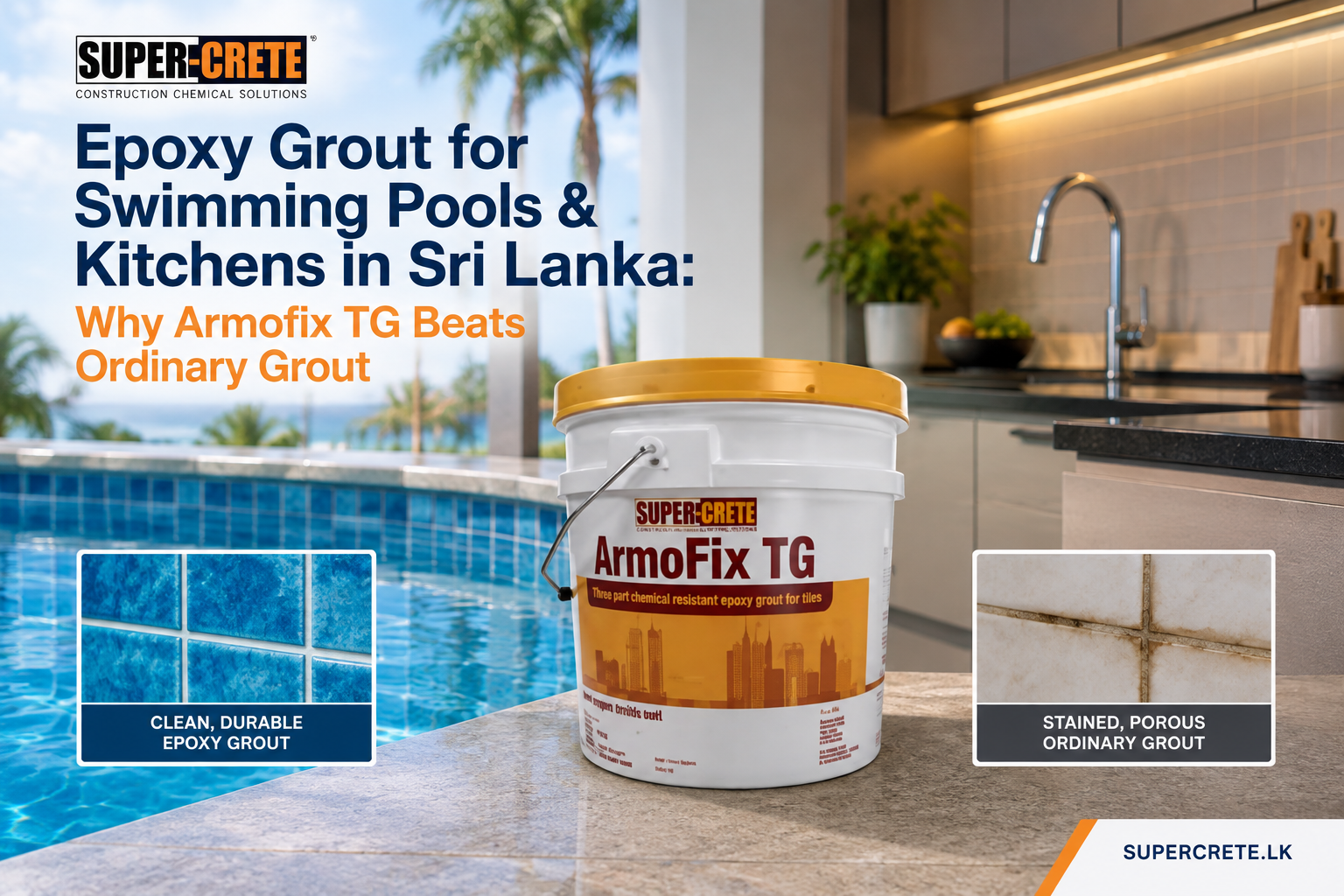
Epoxy Grout for Swimming Pools & Kitchens in Sri Lanka: Why Armofix TG Beats Ordinary Grout
Give it a year. Pool tile grout that was bright white on installation day turns grey, then black, right along the waterline. A kitchen counter's grout near the sink stains no matter how often it's scrubbed. In both cases, the tiles are usually fine — it's the grout underneath that failed.
Ordinary cement-based grout is porous. It absorbs water, chlorine, oils and acids from whatever sits on it, and once it's absorbed something, no amount of surface cleaning gets it back out. In Sri Lanka's climate — constant humidity, chlorinated pool water, kitchens that see oil and acidic food daily — that porosity is a design flaw waiting to show itself.
Why Cement-Based Grout Struggles in Pools and Kitchens
- Pools: chlorinated water cycles through the grout constantly, gradually breaking it down and eventually letting water track behind the tiles.
- Kitchens: oil, turmeric and acidic food stains soak in permanently — cleaning only removes what's on the surface, not what's already absorbed.
- Commercial and industrial areas: routine cleaning chemicals in kitchens, labs and food processing floors degrade ordinary grout faster than daily household use ever would.
What Epoxy Grout Does Differently
Epoxy grout cures into a dense, non-porous surface instead of a porous cement matrix. It doesn't absorb water or oil, resists acids and alkalis, and — unlike cement-based grout — doesn't need periodic resealing to keep performing. It costs more per pack and takes more care to apply, but for anything that sits in water or food-grade conditions daily, it's solving a different problem than cement grout is built for.
Where It Actually Matters in Sri Lanka
- Swimming pools — especially the waterline band, where wet/dry cycling is most aggressive.
- Home and commercial kitchens — countertops, splashbacks, and floors near sinks and cooking areas.
- Bathrooms and other wet walls exposed to daily water.
- Laboratories, clinics and food processing floors, where a hygienic, chemical-resistant surface isn't optional.
SUPER-CRETE Armofix TG
This is exactly the gap SUPER-CRETE Armofix TG is built for — a 3-component, chemical-resistant epoxy grout for ceramic tiles and natural stone, suitable for both internal and external areas. It's formulated to resist acids, alkalis, oils and staining, which is exactly the combination that wears down ordinary grout in swimming pools, kitchens, laboratories and food processing plants.
Grout Is Not a Waterproofing Membrane
One thing worth being clear on: even the best epoxy grout only seals the joints between tiles — it isn't a substitute for waterproofing the surface underneath. A swimming pool shell or a wet-area wall and floor still needs a proper waterproofing membrane applied before tiling. For wet areas prone to movement or hairline cracking, SUPER-CRETE Duraflex Ultra is built for that; for tanks and pool shells, SUPER-CRETE Duraseal XP seals the concrete itself. Epoxy grout and a proper waterproofing membrane are solving two different problems — used together, that's what actually keeps a pool or wet area watertight for the long term. Browse the full waterproofing product range to see what fits your project.
A Note on Application
Three-component epoxy grouts have a shorter working time than cement-based grout and need the mixing ratio and cleaning timing to be right — get it wrong and it's far harder to fix than a cement grout mistake. For a full pool or a commercial kitchen floor, it's worth using a tiling contractor who's actually applied epoxy grout before, not just cement grout.
Whether you're finishing a new pool, renovating a kitchen, or fitting out a space that needs to meet hygiene standards, choosing the right grout — and pairing it with proper waterproofing underneath — is what determines whether it still looks and performs the same way in five years. Browse Grouts & Mortars, or get a free quote and we'll help you specify the right system for your project.