
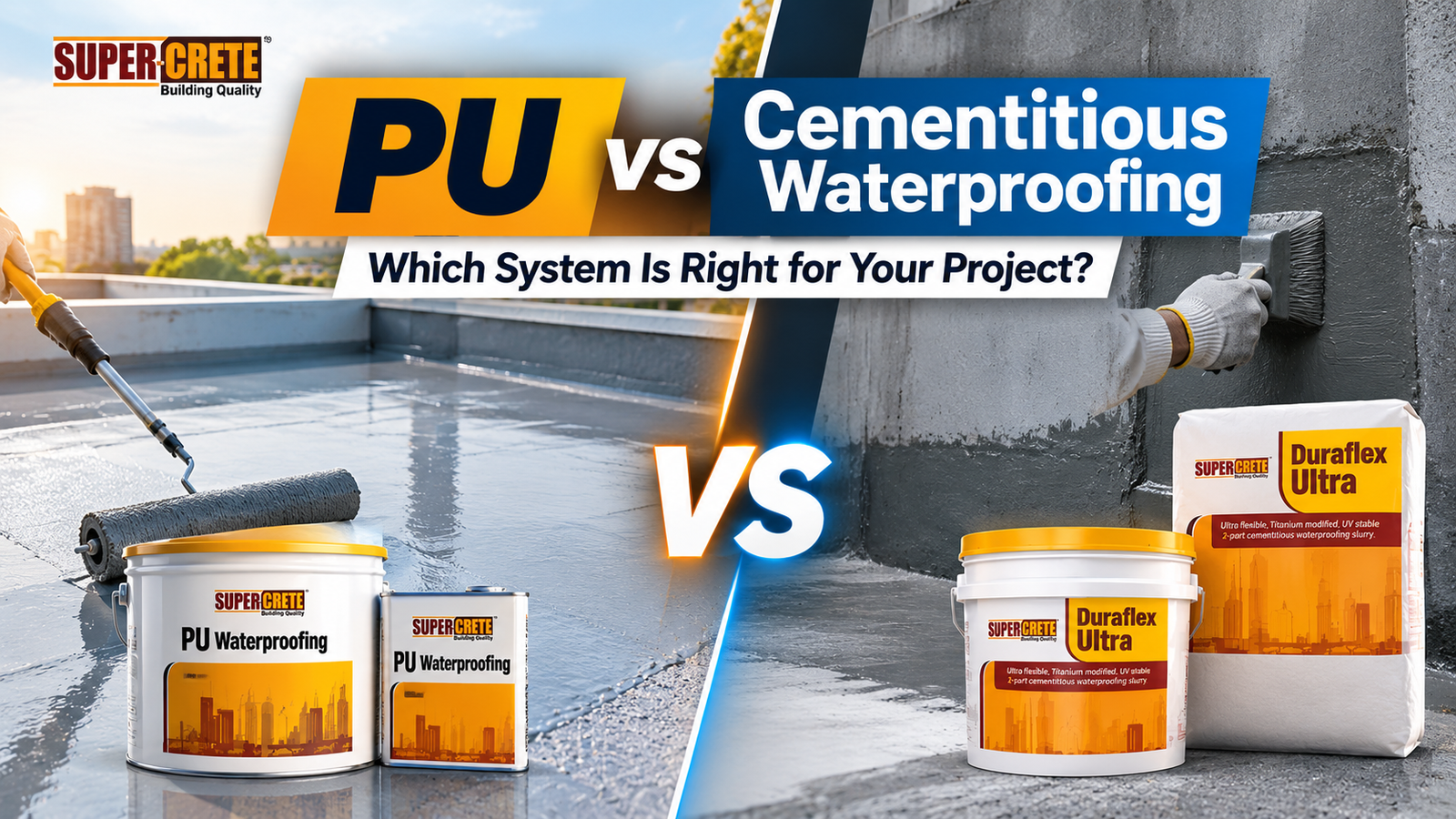
PU vs Cementitious Waterproofing: Which System Is Right for Your Project?
Ask five contractors which is better, polyurethane (PU) or cementitious waterproofing, and you'll get five different answers. The honest one: neither is better — they're built for different surfaces, and most real projects actually end up using both, just in different places. Here's what each one actually is, and how to tell which one your project needs.
Cementitious Waterproofing
A cement-based slurry, mixed with water and brushed or trowelled on like a thick paint. It bonds directly into the surface of concrete, masonry and blockwork, sealing the capillary pores that let water through. Flexible versions — like SUPER-CRETE Duraflex100 and Duraflex Ultra — also bridge hairline cracks, while a basic slurry like Duraseal XP is a straightforward option for surfaces that don't need crack-bridging.
- Strengths: bonds very well to concrete and masonry, straightforward to apply, cost-effective, works well below ground and in enclosed wet areas.
- Best for: bathrooms and wet areas before tiling, water tanks and sumps, foundations and retaining walls.
PU (Polyurethane) and Acrylic Membranes
A liquid-applied coating that cures into a seamless, elastic, rubber-like membrane with no joints for water to find its way through. SUPER-CRETE Duraproof PU 550 is a one-component polyurethane membrane built for heavy exposure — the system used on infrastructure like bridge decks. SUPER-CRETE Duraproof AC 300 is a 100% acrylic version suited to residential rooftops and exposed terraces.
- Strengths: highly elastic — handles constant thermal expansion and contraction far better than a rigid coating, excellent UV and weather resistance, fully seamless once cured.
- Best for: exposed rooftops and terraces, podiums, bridge decks — anywhere the surface takes direct sun and rain, and moves constantly as a result.
Side by Side
- Application: cementitious is brushed on like a thick paste; PU/acrylic is rolled or sprayed on as a liquid that cures into a membrane.
- Flexibility: flexible cementitious slurries bridge hairline cracks; PU and acrylic membranes stretch and recover across a wider range of movement.
- Typical exposure: cementitious suits enclosed or below-grade surfaces; PU/acrylic is built for surfaces in full, constant sun and rain.
- Substrate: both bond well to concrete and masonry — the choice comes down to exposure and movement, not the base material.
Decide by Surface, Not by Preference
- Bathroom or wet area wall before tiling: cementitious — Duraflex Ultra or Duraflex100.
- Water tank or sump: cementitious — Duraseal XP.
- Exposed roof or terrace: acrylic or PU — Duraproof AC 300.
- Bridge deck or heavy infrastructure: PU — Duraproof PU 550.
Most Projects Actually Need Both
A typical house doesn't pick one system for the whole building — it uses cementitious slurry in the bathrooms and water tank, and a PU or acrylic membrane on the exposed roof. They're not competing products; they're solving different problems on different parts of the same structure. Trying to use one system everywhere, just because it worked well in one spot, is one of the more common — and expensive — waterproofing mistakes we see.
Not sure which combination your project needs? Browse the full waterproofing product range, or get a free quote and tell us what you're building — we'll help you specify the right system for each surface.