
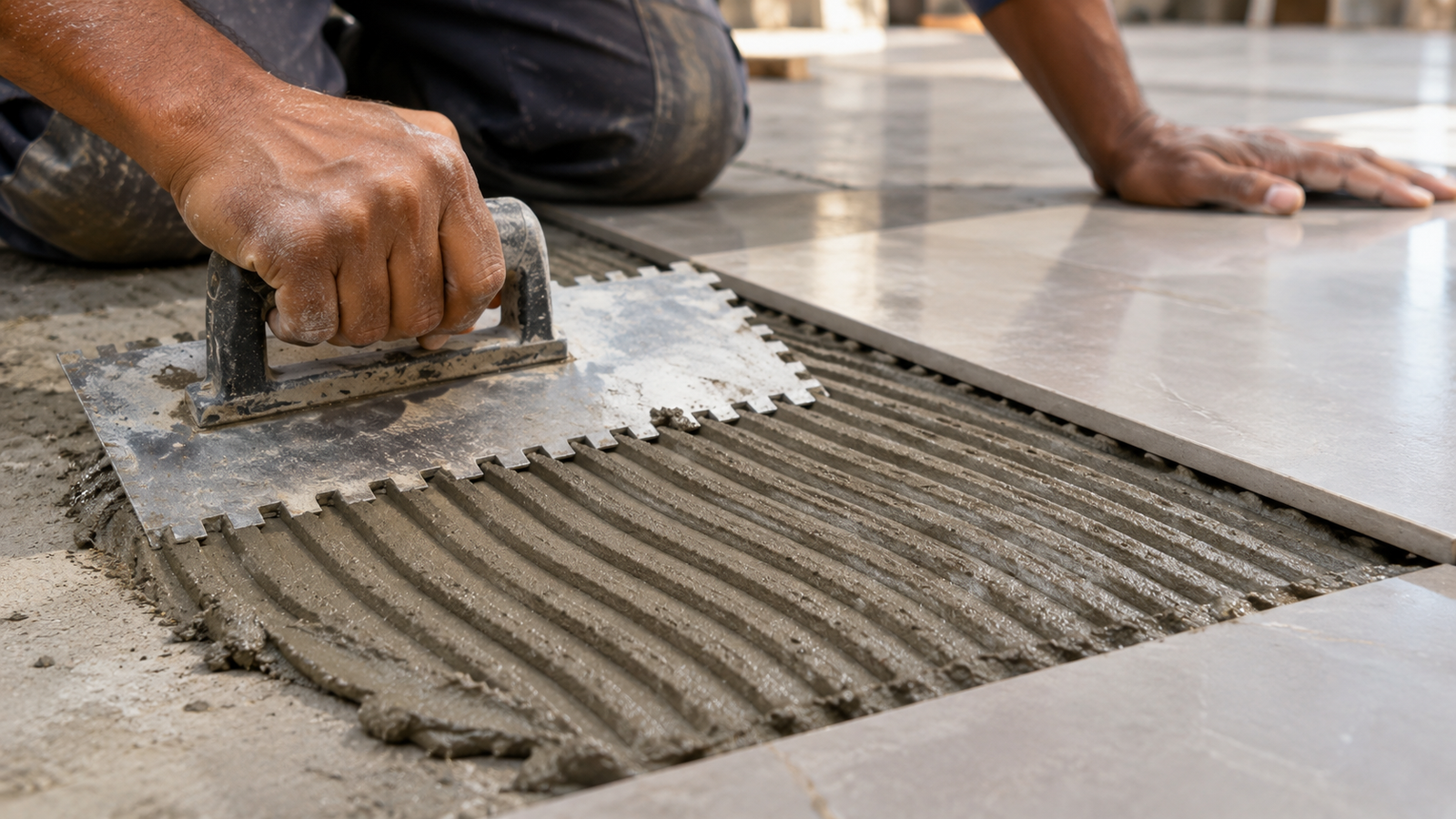
A tile that sounds hollow when you tap it, or pops loose a year after installation, gets blamed on bad workmanship almost every time. Often the tiler did nothing wrong at all — the adhesive underneath simply wasn't rated for the tile, the surface, or the conditions it was asked to handle. Here's what actually determines the right adhesive, and how to tell which one your project needs.
C1 vs C2: What the Classification Actually Means
Tile adhesives are classified under the European standard EN 12004 — you'll see "C1" or "C2" on technical datasheets, including ours. It's not marketing language; it's a tested bond-strength rating.
- C1 (normal): standard cementitious adhesive, adequate bond strength for everyday indoor ceramic tiling — small to medium wall and floor tiles in dry, low-stress conditions.
- C2 (improved): higher bond strength, tested to hold under more demanding conditions — larger tiles, porcelain, natural stone, exterior exposure, and areas with moisture or temperature movement.
Use a C1 adhesive where C2 is actually needed and the failure isn't a question of if, just when — often within the first year as the tile experiences its first real thermal cycle or gets walked on with real weight.
"No Vertical Slip" and "Extended Open Time" — Why They Matter
- No vertical slip: a wall tile shouldn't slide down the wall under its own weight before the adhesive sets. This matters far more for large-format wall tiles than small mosaic pieces.
- Extended open time: how long the adhesive stays workable after it's spread, before a skin forms on the surface. A longer open time gives installers more real working room on a large area — genuinely useful on bigger jobs, not just a spec-sheet number.
The FlexBond Range, Mapped to Real Projects
SUPER-CRETE Flexbond HX — a straightforward cement-based adhesive for everyday ceramic wall and floor tiling indoors. The right choice for a standard home bathroom or kitchen wall with small to medium ceramic tiles and no unusual exposure.
SUPER-CRETE FlexBond FX — polymer-modified, with no vertical slip and extended open time, for both internal and external fixing of ceramic, porcelain and natural stone. A sensible step up from HX whenever the tile type or the exposure moves outside "everyday indoor ceramic."
SUPER-CRETE Flexbond LX — classified C2 TE under EN 12004, with high bond strength, moisture resistance and zero slip. Built for wet areas and installations where both strength and moisture resistance genuinely matter, not just one or the other.
SUPER-CRETE FlexBond RX — the top of the range: ultra-flexible, no vertical slip, extended open time, built for large-format tiles and natural stone in demanding installations. This is the one to reach for on big porcelain slabs or stone, where a lesser adhesive is most likely to fail.
Matching the Adhesive to the Project
- Standard indoor ceramic wall or floor tiling: Flexbond HX.
- Mixed indoor/outdoor, ceramic, porcelain or natural stone: FlexBond FX.
- Wet areas — bathroom floors, pool surrounds, anywhere moisture resistance matters: Flexbond LX.
- Large-format tiles or natural stone, demanding installs: FlexBond RX.
One Thing Tile Adhesive Doesn't Do
None of these are a waterproofing product, even the moisture-resistant ones. In a bathroom, pool surround or any wet area, the surface still needs a proper waterproofing membrane applied before tiling — the adhesive bonds the tile, it doesn't seal the substrate underneath. See our guide on PU vs cementitious waterproofing for what goes on first, and our grout comparison for what goes on last. Waterproofing, then tile adhesive, then grout — each layer solves a different problem, and skipping one doesn't get made up for by the other two.
Browse the full Tile Adhesives range, or get a free quote and tell us about your project — we'll recommend the right one.